Nov. 2024 — Now
Postdoc
Connecting cosmological initial conditions to supermassive black hole merger timescales and the properties of merger remnants.

I’m a Post-doctoral researcher at the University of Surrey, specialising in galactic dynamics. My research focuses on the dynamics and mergers of massive black holes across different mass scales. This ranges from supermassive black holes in the centers of elliptical galaxies, relevant to pulsar timing array detections of the gravitational-wave background, to intermediate-mass black holes in dwarf galaxies, where off-center mergers present unique dynamical challenges and may be key sources for LISA. My approach combines high-resolution N-body simulations, cosmological simulations and theoretical studies of few-body dynamics.
Connecting cosmological initial conditions to supermassive black hole merger timescales and the properties of merger remnants.
Off-centre mergers of massive black holes in dwarf galaxies and the role of gravitational capture.
Particle Physics, QFT & Cosmology.
Fundamental Physics.
Recent Pulsar Timing Array (PTA) observations have revealed a stochastic gravitational wave background consistent with the combined signal of numerous supermassive black hole (SMBH) binaries. Interpreting this signal requires a precise understanding of how SMBHs merge across cosmic time. However, cosmological simulations and semi-analytic models lack the spatial resolution to follow the detailed dynamical evolution of SMBHs within galaxies.
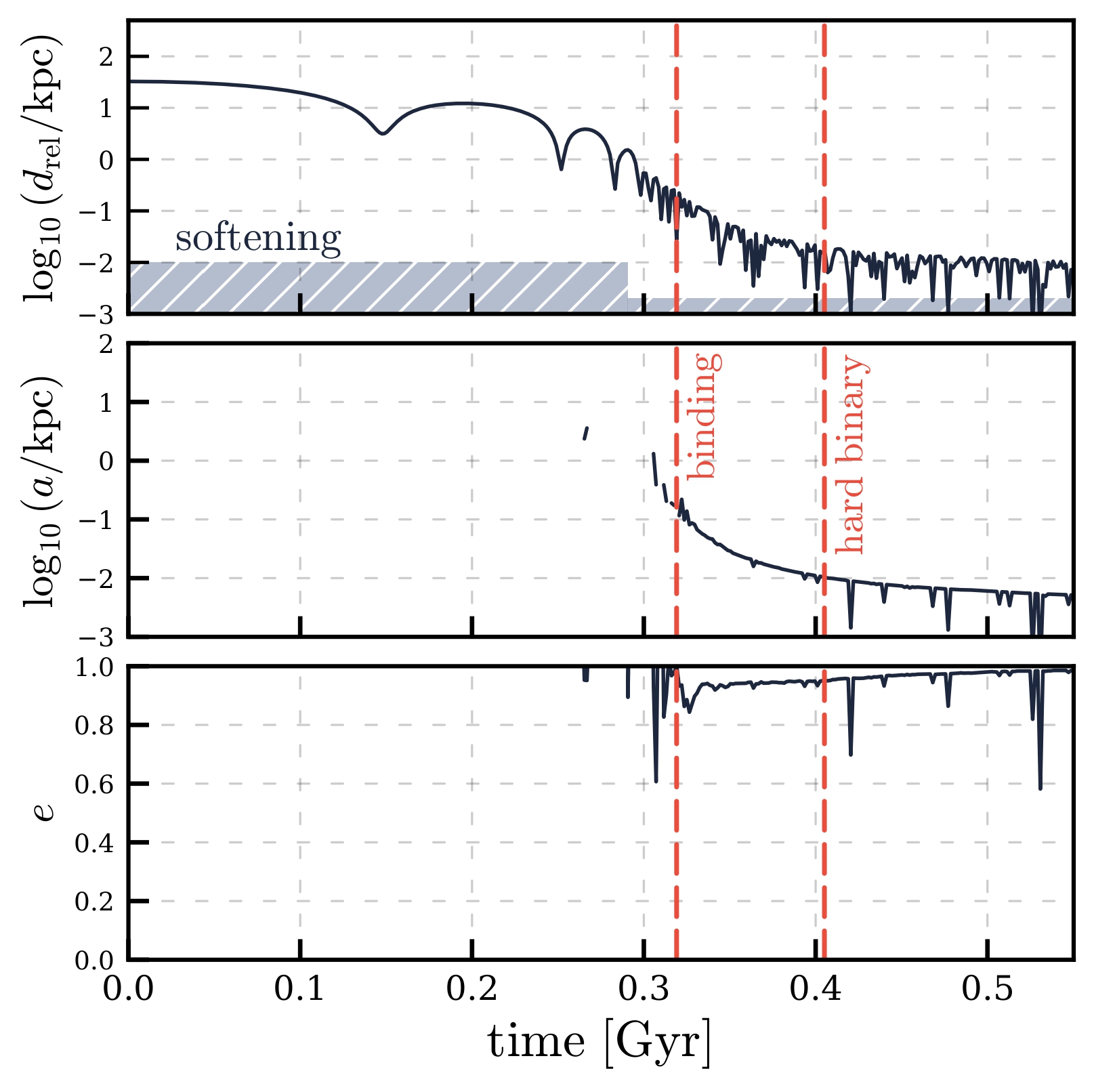
In my current work, I identify PTA sources from the cosmological simulations IllustrisTNG, and re-simulate them at much higher resolution using N-body integrations. These simulations capture the gravitational interactions that drive the SMBHs from kiloparsec to sub-parsec separations, ultimately leading to coalescence. I investigate how the initial conditions of galaxy mergers determine SMBH merger timescales, developing scaling relations that connect galaxy and orbital properties to binary evolution. I also study the structural and kinematic properties of merger remnants, with a particular focus on how SMBH binaries shape the formation and evolution of galactic cores.
Over the last decades, massive black holes have been discovered at the centers of both massive and dwarf galaxies, suggesting a shared history between them and their hosts. The conventional picture of black hole mergers involves a three-phase process starting by their infall towards the galaxy center due to dynamical friction. However, this picture may not hold in low-density systems like dwarf galaxies, where the infall time can significantly exceed the Hubble time or black holes may be halted by core stalling, which would result in a large population of off-center intermediate mass black holes. Hence, it is essential to inquire whether mergers beyond the central region are possible, as this could bear notable consequences for the black hole mass assembly.
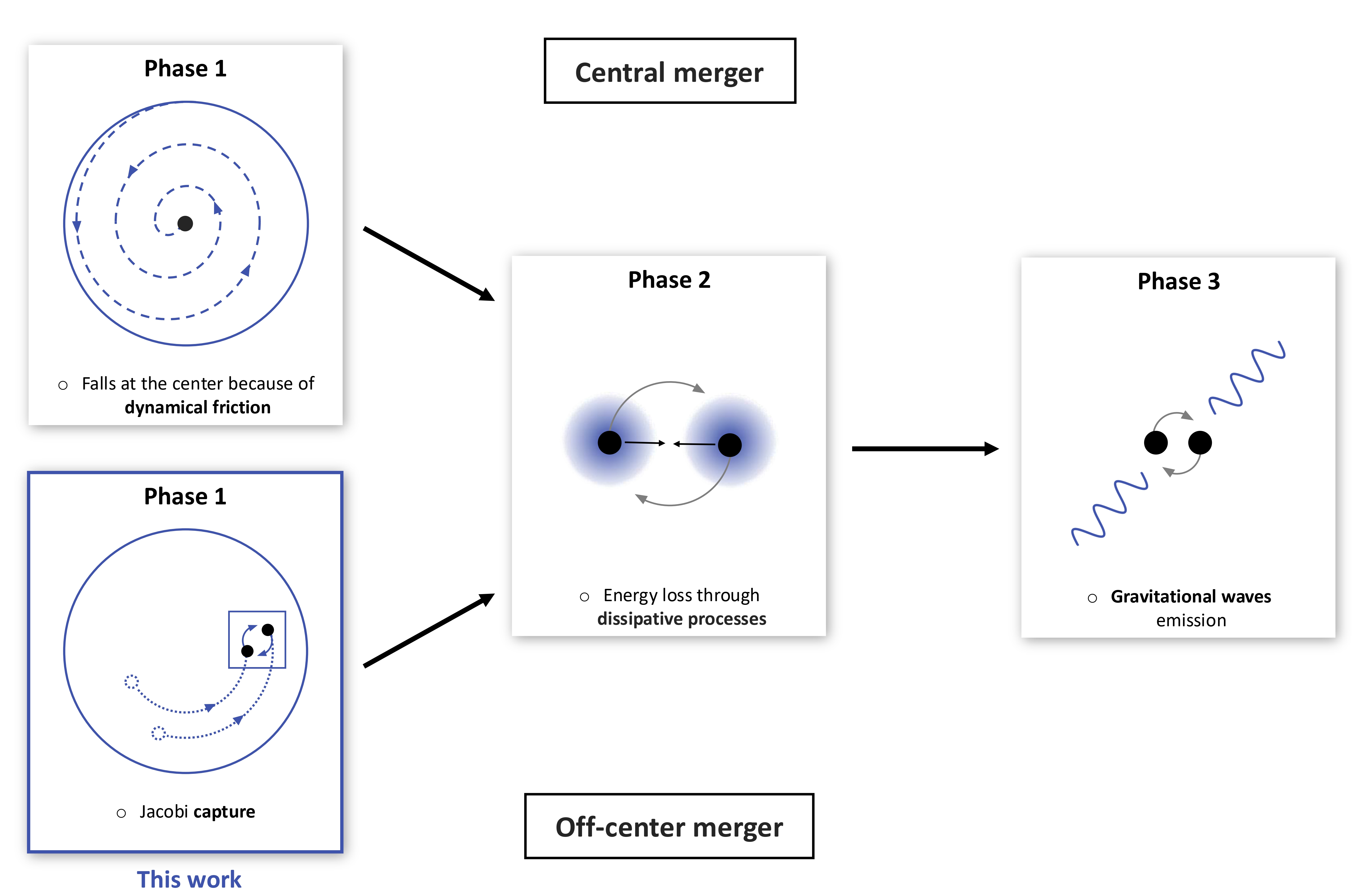
For a merger to occur outside the galactic center, it is first necessary for the two black holes to meet a suitable configuration where their gravitational attraction becomes comparable to the force generated by the galaxy. It facilitates temporary captures, known as Jacobi captures, marked by multiple close encounters. I've been interested in these captures: their probability, their dependence on the initial conditions and their chaotic structure.
In the standard cold dark matter paradigm, galaxies are typically associated with a surrounding, extended dark matter halo. However, whereas cosmological simulations predict these halos to have steep, "cuspy" inner density profiles, observational evidence tends to support shallower "cores", marked by a flattening of the density profile at the center of the halo. To reconcile this difference, it's suggested that feedback mechanisms from stars and active galactic nuclei (AGN) play a crucial role. Stellar winds, supernova explosions, and AGN activity release energy that can dynamically heat dark matter halo, leading to the formation of a core.

I worked on a model to explain dark matter core formation from a sudden gas outflow (Freundlich et al. 2020a). My aim was to test the validity of this model using galactic-scale N-body simulations. I studied the response of an equilibrium dark matter halo to an abrupt outflow (or inflow) of baryonic matter at the center, and compared it with the predictions of the theoretical model. I also studied the influence of the number and frequency of outflow episodes on core creation.
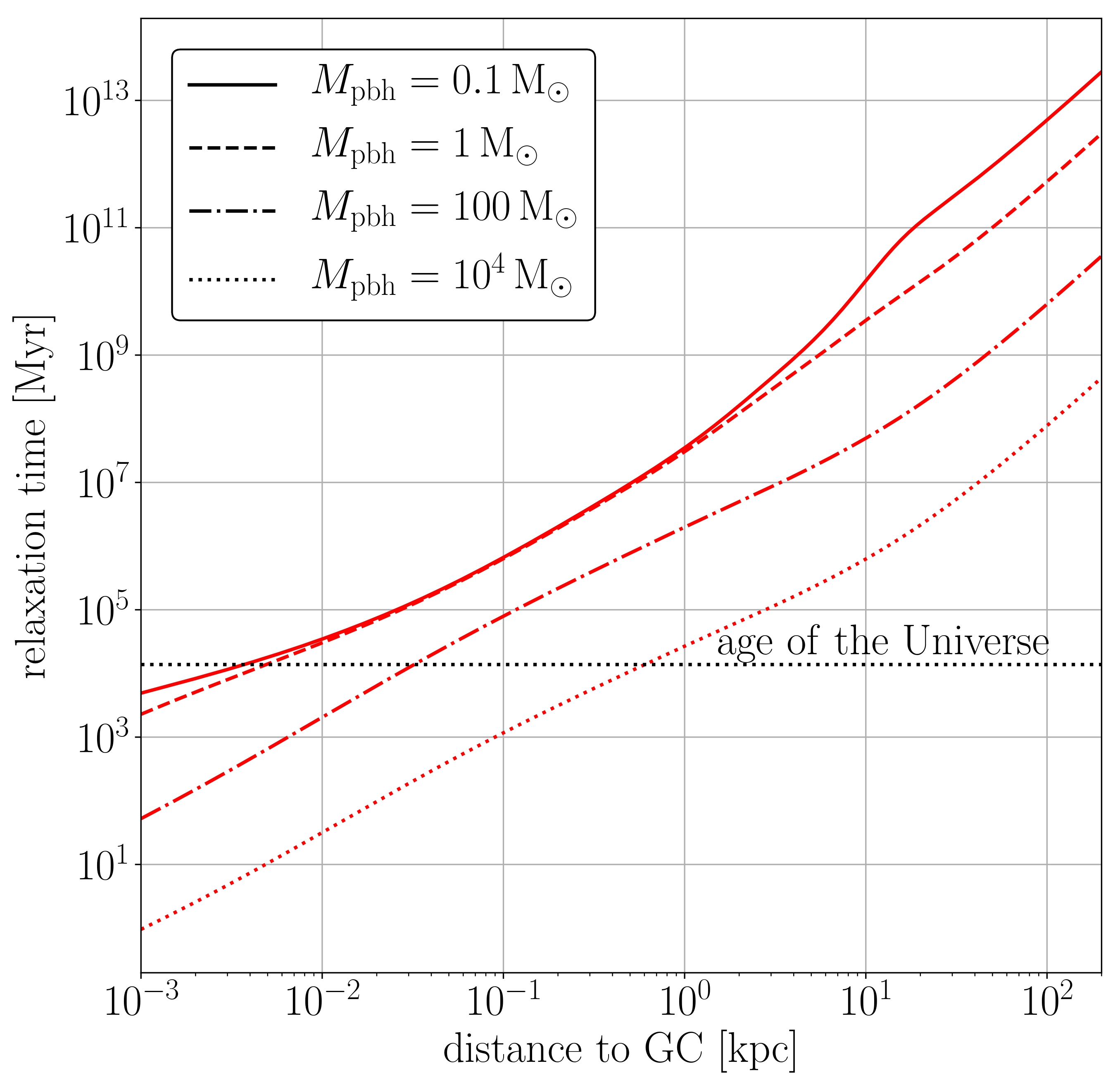
To this day, considerable uncertainties persist regarding the nature of dark matter. A few years ago, I was interested in an alternative scenario of dark matter composed of primordial black holes. I looked at the dynamical consequences of this hypothesis on a galactic scale. First, I calculated the relaxation time of this dark matter to see if it can be described by the typical collisionless profiles used in the literature. Then, I looked at the effect of dynamical friction on these primordial black holes to determine whether this could be responsible for a mass accumulation leading to the formation of a supermassive black hole.
 Submitted version
 arXiv
 ADS
arXiv
ADS
arXiv
ADS
arXiv
ADS
arXiv
ADS
arXiv
ADS
Postdoctoral Research Associate
School of Mathematics and Physics
University of Surrey
Guildford GU2 7XH